You’ve watched the YouTube videos. You’ve tied flies at the kitchen table until midnight — Copper Johns and RS2s and midge clusters, with the concentration of someone defusing something important. You’ve read the reports, bought the map, driven two hours to stand in a river that clearly, visibly, undeniably has fish in it.
You went home empty.
This is not a failure of effort. It’s a failure of information — and the gap between what you know and what the river requires on any given morning is not something you can close from a screen. It closes on the water, next to someone who’s been reading the same seams for decades.
What a Guide Actually Does
There’s a version of this conversation that reduces guiding to catching more fish. That’s true, but it misses the point. A guide doesn’t just improve your catch. He changes the way you read water.
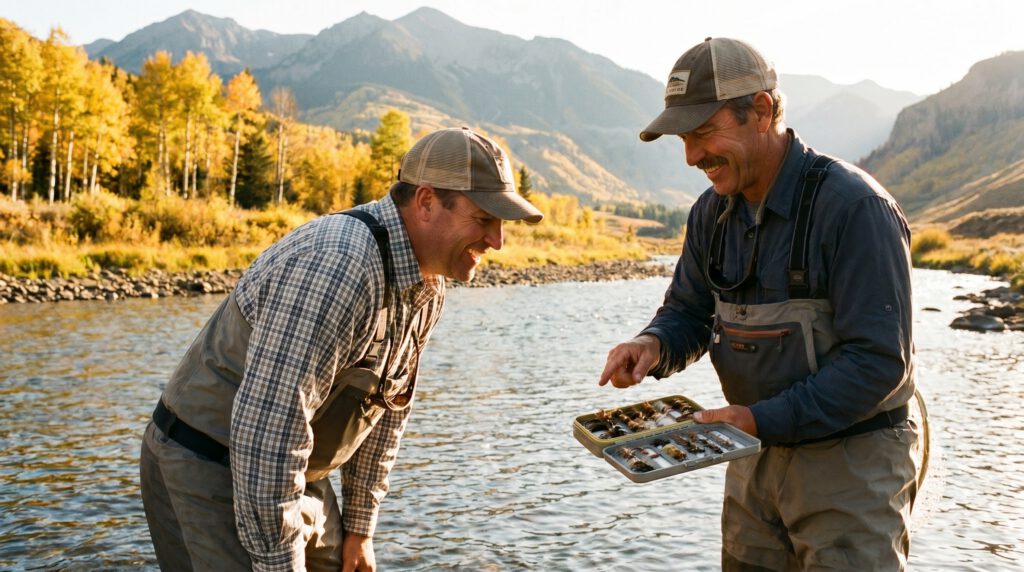
By the end of a day on the South Platte with one of our guides, you’ll understand why the fish are holding in that specific seam and not the one ten feet upstream. You’ll understand why the size 22 midge cluster is the fly at 9 a.m. and why the afternoon will ask for something different — not because someone handed you a schedule, but because you watched it happen in real time with someone who could explain the why while it was unfolding in front of you.
That knowledge doesn’t stay on the river. It comes home with you. Every subsequent trip, you’re fishing with that day layered underneath it. The river becomes more legible. The guesswork compresses.
The Waters We Know
Our guides work the South Platte system with the familiarity that only comes from showing up year after year on the same water in every condition. From the demanding tailwaters of Cheesman Canyon — where the fish are large, selective, and operating with a professional-grade suspicion of anything that doesn’t look exactly right — to the wide meadow bends of the Dream Stream, where a well-placed size 20 RS2 in the film can bring up a brown trout that will make you question your previous understanding of the word.
We also guide on the Blue River near Silverthorne, the Cache la Poudre above Fort Collins, the Big Thompson through Estes Park, and several stretches of private water that aren’t available to you unless you come with someone who has the relationship. That access is part of what you’re booking. The expertise is the other part.
There is no single piece of the Front Range where our guides are unfamiliar. They’ve fished these rivers in March ice and August heat, in runoff and low water, on the days when everything is eating and on the days — rarer than you’d think — when nothing is. Both kinds of days teach you something, and both are better with a guide who’s lived through enough of them to know which adjustments to make and when to stop adjusting and just be on the river.
James Parker Has Been Reading This Water for a Long Time
The man who built Arbor Anglers didn’t arrive in Colorado with a prepared resume. James Parker grew up in Texas, the son of two Navy veterans, fishing the kinds of water you fish because it’s there — farm tanks, coastal estuaries, Gulf Coast flats where the redfish run in the afternoon heat and the presentation window is measured in seconds. He learned to read moving water on Nebraska creeks. He spent years on the Texas and Florida coasts chasing saltwater species with a fly rod before the mountains pulled him west.
He appeared on Survivor. He’s guided in Patagonia. He’s led first-time anglers to their first trout and taken seasoned anglers to the best fish of their lives, and he treats those two days with the same care.
The guides he’s assembled around him carry the same ethic. Brandon, Charlie, Chris, Sean, Travis, Trevor, Tyler — each of them with their own relationship with Colorado water, their own years of local knowledge, their own ability to read the person standing next to them in the river and understand what kind of day they actually need.
What to Expect When You Book
A guided trip with Arbor Anglers is not a tour. You are not following someone through scenery. You’re in a working partnership with a professional whose singular goal is to make you a more capable angler by the time you step out of the river.
That means honest feedback when your cast is pulling left. It means a fly change before you’ve decided you need one, because your guide saw the fish reject your presentation twice in a row and already knows why. It means adjusting the day around your energy and your skill level — pushing when you’re ready, slowing down when the river is asking for patience, and knowing the difference.
Half-day and full-day options are available for individuals, pairs, and small groups. If you’re new to fly fishing, a guided trip is the single highest-leverage thing you can do. If you’ve been fishing for years, it’s the fastest way to find the ceiling of what you currently know — and then push through it.
We also offer group trips for larger parties, destination travel for anglers ready to take their experience beyond Colorado, and gift certificates for the person in your life who has been putting this off for too long.
The River Is Not Waiting for You to Figure It Out
The South Platte is running right now. The fish are in the water, holding in seams that have been holding fish since before either of us were here. Somewhere in a bend below a foam line on a stretch of river that our guides know like a second home, there is a brown trout feeding on midges with the focused indifference of an animal that has seen everything — except your fly, presented correctly, at the right depth, on the right drift.
Book a guide trip. Let us close that gap.
Arbor Anglers’ professional guides serve the South Platte, Blue River, Cache la Poudre, Big Thompson, and private Front Range waters. We’re based in Lafayette, Colorado — between Denver and Boulder — and available for half-day, full-day, and group trips. Book a guided trip or contact us to start planning.